
Searching Lincoln County Criminal Dockets
Most people search Lincoln County criminal records through the free North Carolina eCourts Portal. Start at Smart Search. You can enter a record number if you have one, or type a name and then narrow the statewide hits to Lincoln County. Portal opened for Lincoln cases in October 2025. Its Case Summary serves as the public Register of Actions, pulling together case information, hearings, events, dispositions, and any financial information. A name match deserves a close look. After a basic search, the official Portal guide lets you filter by location, date of birth range, case type, status, and filing dates. Public results hide the month and day of a birth date. If you hit the 200-result warning, add a Lincoln filter rather than trusting the first screen. Portal is for search and viewing only. To file, use North Carolina File & Serve where e-filing applies.
- Open the official Portal and select Smart Search.
- Enter the record number, or enter a name and then set Location to Lincoln County.
- Use Criminal or Infraction case type and a filing or status filter only when they help distinguish results.
- Open the matching record number and read the Case Summary, especially Case Events, Hearings, Dispositions, and Assignment Information.
- Use the Lincoln criminal calendar or contact the clerk when a setting, paper file, certified copy, or restricted record needs confirmation.
Note: A public Portal account is optional. It only adds saved-case features and does not unlock restricted criminal information.
Lincoln County Criminal CR and IF Codes
An Enterprise Justice record number has four parts: a two-digit year, case-type letters, a six-digit sequence, and a three-digit county identifier. The judiciary's example is 21CR000003-910. Those letters are a handy first clue. CR means the case holds at least one criminal charge. IF means infractions only. The code still does not replace reading the charge or assignment section.
- Case Event
- A dated item in the Portal chronology. It is an event index, not automatically the underlying document image.
- Assignment Information
- The Case Summary block that identifies the court or assignment context for the Lincoln case.
- Transferred to Superior Court
- A documented status that signals a related Superior Court record may need to be checked.
That four-part format is a current Portal convention. An older paper file may carry a number that breaks the pattern. When an old identifier fails, the Lincoln County Clerk of Superior Court is the documented fallback.
Inside a Lincoln County Criminal Docket
The Case Summary is more than a caption. It gathers the record number, case information, court assignment, parties, dated Case Events, hearing settings, disposition information, and any financial information. A status label alone is not the whole result. Read the events in date order to see what a hearing, filing, or outcome really means.
| Record number | The Enterprise Justice identifier, such as 21CR000003-910, used to open the correct Lincoln County case. |
|---|---|
| Case and assignment information | Core type, status, and court-assignment context for the criminal matter. |
| Party information | Publicly available participant information. Portal masks the month and day of a displayed birth date. |
| Case Events and hearings | The dated record chronology and scheduled proceedings. Search Hearings adds current location and time. |
| Disposition and financial information | The recorded outcome and, when applicable, current financial details. Use the complete Case Summary rather than a judgment-index snapshot. |
A listed case event does not promise a matching document image. Images can be missing because of upload timing, public-access limits, confidentiality, or a court restriction.
Lincoln County Criminal Statuses
Portal's criminal and infraction statuses include Pending, Disposed, Completed, Archived, Appealed–Appellate, and Pending Expungement. The list also covers Remanded, Transfer to Another County, Transferred to Superior Court, and Voluntarily Dismissed with Leave. These labels help sort results. None should be stretched past what the Case Summary shows. Disposed, for instance, means a disposition was recorded. It does not account for every event, financial action, or later development. Pending Expungement is not proof the record is gone. And Voluntarily Dismissed with Leave is its own status. It is not a not-guilty verdict or an expunction order. Check the event list and disposition fields for what the court actually entered. The official Portal training resources point to Smart Search for the complete current Case Summary. Judgment Search works as an index. But the guidance sends users back to Smart Search for current case financial information.
How a Criminal Case Moves
A Lincoln County criminal docket usually opens with charging process and a record number. From there, Case Events may show release or bond activity, a setting, a plea or trial event, a disposition, costs, and later action. Portal supplies the event labels, so treat the result as a dated sequence rather than a prediction of what comes next.
Docket flow: Filing → Arraignment → Pretrial → Plea or Trial → Disposition → Sentencing
Felonies are tried in Superior Court. Misdemeanors and infractions usually start in District Court. A District Court result can be appealed for a new trial in Superior Court, so an entry like Transferred to Superior Court or Trial De Novo may point to the next Lincoln County docket, not a final end.
Lincoln County Criminal Hearing Search
Start with the Case Summary and open its Hearings component. That block ties a setting to one specific Lincoln County case. The Portal also offers Search Hearings, a current-calendar tool that accepts a case number, party name, business name, attorney name, bar number, judicial officer, or courtroom. It returns a hearing location and time. One gap matters here. The official materials say it does not indicate whether a hearing is virtual or in person. So confirm that detail with the clerk.
The Lincoln criminal calendar is a second official channel for a session list. It serves a different purpose from the individual Case Summary. A calendar can show an upcoming court session. The record's hearing block, by contrast, connects the setting to the particular criminal case.
Courts That Hold Criminal Dockets
Lincoln County runs one clerk operation rather than separate criminal and civil docket offices. The Lincoln County Clerk of Superior Court keeps the court file and docket. It covers both Superior and District Court matters. District Court handles misdemeanors and infractions. Superior Court handles felonies and receives misdemeanor or infraction appeals for a new trial. Magistrates sit inside the District Court structure. There they may issue process, set bail, and accept certain minor pleas.
So North Carolina District Court is the usual starting level for an infraction or misdemeanor. Meanwhile, Superior Court is the trial division for felonies. Before assuming a Lincoln County criminal matter belongs to one division, check the Case Summary's assignment and status.
The District Court jurisdiction overview shows the lower trial division. That division handles criminal and infraction matters in Lincoln County.
This division split shapes how you search. A Lincoln County criminal search should include the court assignment and any transfer status, not only the charge description.
Lincoln County Criminal Magistrate Records
Magistrates handle process and bail questions in Lincoln County. But they run no separate county-branded docket site. The criminal case record stays with the clerk. Reach it through the common Portal or the clerk's office. Their listed number is (704) 742-7819. The clerk and courthouse number is (704) 742-7800. The Lincoln County contact directory keeps those office contacts separate and clear.
For a pending charge, the docket route is Portal. You can also use the criminal calendar, or the clerk's public terminal and paper file. For the underlying process or bail question, call the magistrate instead.
Sealed Dockets and Public Access
Portal does provide public criminal Case Summaries. Still, court access has real limits. Sealed, confidential, sensitive, and restricted material is not displayed online. North Carolina law withholds juvenile records from public inspection. An expunged or sealed record will no longer appear online. A missing result can therefore call for a clerk inquiry. It is not grounds for an assumption about a case outcome.
Lincoln County access rules: G.S. 7A-109 requires the clerk to keep dockets and opens clerk records for inspection except where access is prohibited by law. G.S. 7B-3000 limits public inspection of juvenile records. G.S. 132-1.4(k) identifies specified returned criminal process records as public unless sealed by court order.
North Carolina expunction guidance explains that eligibility and filing routes vary by charge, age, and outcome. An eligible Lincoln matter is filed with the Lincoln clerk. The guidance is not a promise that a particular case qualifies.
Expunction is one practical reason a Lincoln County criminal docket you expected to find may not appear in the public search.
The juvenile-record confidentiality statute sets the legal limit for juvenile files in Lincoln County.
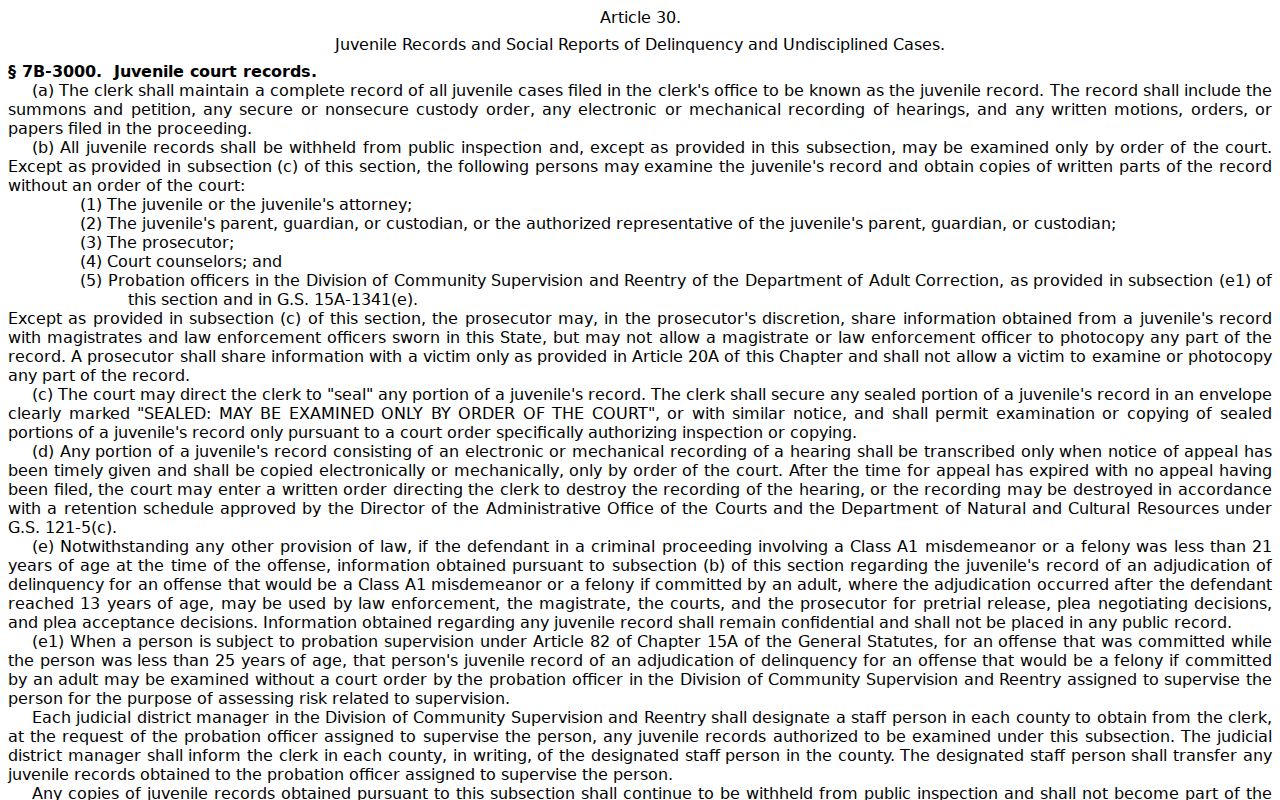
That rule stands apart from the ordinary public Case Summary for adult criminal and infraction matters.
Lincoln County Criminal Clerk Fallbacks
When Portal does not answer the need, follow the documented sequence. Try Portal and the county calendar first. Then the courthouse public terminal or paper file. Then paid copies or certification from the clerk. The Lincoln County Courthouse sits at 120 Justice Drive in Lincolnton. There the Clerk of Superior Court is open on weekdays from 8:30 a.m. to 5 p.m. Historical paper files, a certified copy, or a record that is not visible online all call for the clerk. So does a locally held audio record. Skip the repeated browser searches.
Staff copies follow the statewide fee schedule. The first prepared page of each document costs $2. Each additional page or fraction costs $0.25, and a certificate under seal is $3. Those paid services differ from free Portal viewing. A criminal record name search carries its own $25 statutory service. It is not the same as a Case Summary lookup.
Lincoln County Criminal Recovery Court
Lincoln's Community-Centered Court is a recovery-court program, not another criminal docket database. State program information identifies it as a Lincoln County program. It is tied to underlying felony cases and referral functions. The 2025 recovery-court report identifies implementation in 2023. It describes entry at post-sentence, probation, or probation-violation stages. The covered charges are Class H and I felonies.
The Community-Centered Court of Lincoln County provides program information and referral materials.
The associated criminal case is still traced through its ordinary Portal record. It remains subject to the same public-access restrictions as other Lincoln County criminal dockets.